Hardened Washers for Oil & Gas Flanges: A Field Engineer's Guide to EN 14399-6, ASME B16.5 and Pressure-Service Flange Joint Design
During flange assembly audits on Middle East projects, one recurring issue comes up on nearly every site. A supervisor is staring at a pallet of black-oxide flat washers beside a crate of heavy hex structural bolts, and asking the question that has loosened more flanges than corrosion ever has: "Can't we just use any washer?"
The answer is no. A washer is not decorative hardware — it is a calibrated load-distribution component in a preloaded bolted joint. Under the tens of kilonewtons of clamp-up from an M30 A320 L7 stud on a Class 900 flange, a soft, unhardened washer will yield, embed into the flange face, and quietly destroy the preload you spent two days torquing in. By the time the joint leaks at pressure test, the washer still looks fine. That is what makes it dangerous.
This guide is written for the EPC engineers, piping spec writers, procurement managers and foremen building and maintaining facilities across the Middle East. We cover what hardened washers are, how EN 14399-6 HV washers differ from the hardware-shelf variety, what ASME B16.5 and API 6A expect under a flange nut, how hardness matching works, and the field mistakes that keep commissioning teams up at night.
Why Washers Matter in High-Strength Oil & Gas Bolted Joints
A bolted flange joint does not work by friction between nut and flange. It works because the bolt is stretched like a stiff spring, and the resulting axial clamp-up holds the two flange halves together against internal pressure, bending moments and thermal cycling. Every surface in that load path — bolt shank, nut, washer, flange face, gasket — behaves as a spring in series. If any one of them compresses plastically, the preload decays.
The washer sits between the rotating nut (or bolt head) and the contact surface. It has three jobs:
- Distribute bearing load. A heavy hex nut on an M30 bolt presents a bearing area of roughly 1,700 mm². Spread that over soft carbon-steel flange plate and the contact pressure can exceed yield, leading to embedding. A hardened washer spreads that pressure over a larger, harder annulus.
- Protect the contact surface. As the nut turns during torque-up, the underside slides against the flange. Without a hardened washer, galling and fretting wear chew into the flange face — especially on raised-face flanges where the contact band is narrow.
- Provide a consistent friction plane. Torque-tension relationships are only predictable when the under-head coefficient of friction is controlled. A hardened washer with a known surface treatment lets you repeat the torque target joint after joint.
What Is a Hardened Washer, Anyway?
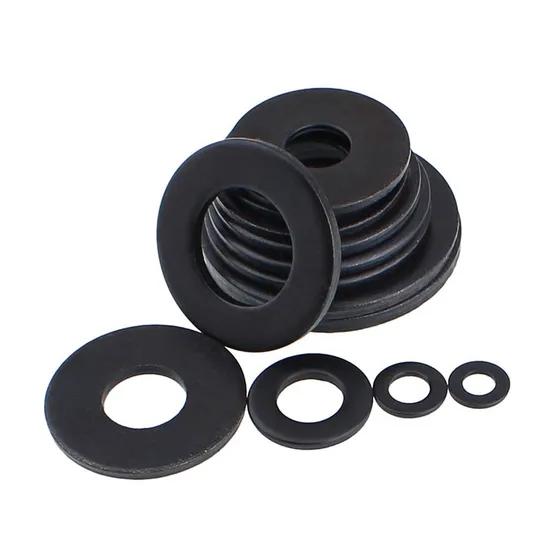
"Hardened washer" is a colloquial term. On a real engineering drawing it means a washer that has been quench-and-temper heat-treated to a defined hardness range, rather than punched from cold-rolled or mild-steel strip in the soft-annealed condition.
For structural and pressure-service bolting, the practical definitions are:
- Structural / hardened flat washers per ASTM F436 / F436M — through-hardened carbon or alloy steel washers for high-strength bolts (ASTM A325, A490 and ISO equivalents). F436 Type 1 covers carbon steel; Type 3 covers weathering / atmospheric-corrosion-resistant steel. Typical hardness is 38–45 HRC (≈ 369–440 HV), with a minimum around 30 HRC so the washer is never softer than the fastener it supports.
- HV washers per EN 14399-6 — the European counterpart, supplied as a matched pair with HR / HV heavy hex bolts and nuts under EN 14399 parts 4 and 5. These are chamfered, through-hardened, and hardness-matched to the bolt/nut set.
- Beveled / taper washers — compensate for non-parallel surfaces on structural beams with sloped flanges.
- Plain commercial flat washers — punched from low-carbon C1008/1010 strip, as-annealed. These are not acceptable under preloaded high-strength bolts, no matter how neatly they fit the hole.
The most useful on-site diagnostic is a small file. Run it across the washer edge. A hardened washer will skate over the surface; a soft commercial washer will take a bite and groove easily. That thirty-second check has caught more wrong-spec shipments than any inspection report.
EN 14399-6: HV Chamfered Washers for Preloaded Flange and Structural Bolting
EN 14399 is the European harmonized standard system for high-strength structural bolting assemblies, and part 6 governs the washers. If your project uses EN 14399-4 HR or EN 14399-5 HV bolt sets — common on European-designed refineries, pipe racks and steel buildings across the MENA region — the washer is not an afterthought. It is part of the CE-marked assembly.
Key points field teams need to know about EN 14399-6:
- HV washers are chamfered on one face, the face toward the nut or bolt head. It removes the sharp punched burr that would dig into the rotating part and skew the friction coefficient, and clears the brittle work-hardened edge away from the nut.
- They are through-hardened and tempered, typically 300–370 HV — slightly harder than the nut's tapping face, but not so hard that the washer becomes brittle.
- They are supplied as matched sets. An HV bolt, nut and washer from the same lot are qualified to work together as a CE-assembly. Mixing a cheaper washer under a certified HV nut voids the assembly's declared CE performance.
- They are intended for preloaded joints. Oil and gas vibration service almost never qualifies as non-preloaded.
- Marking matters. HV washers carry the manufacturer's identification and a hardness code. An unmarked washer from a local hardware bin is not EN 14399-6.
Procurement note: when an RFQ says "EN 14399-6 washers," insist on mill test certificates (EN 10204 3.1) covering hardness, traceability and assembly classification. That MTC is what gets you through the mechanical completion dossier without a re-punch.
The nut that turns on top of these washers is part of the same matched set — see our guide to heavy hex nuts for how A194 2H and HV nut hardness is selected to work with the washer and bolt.
ASME B16.5 Flange Washer Requirements and API 6A Practice
ASME B16.5 itself does not prescribe a washer standard the way EN 14399 does. The flange standard defines dimensions, pressure-temperature ratings, facing and bolting dimensions — it leaves fastener and washer selection to the piping specification, which in oil and gas work almost always pairs B16.5 flanges with ASTM A193 B7 studs and ASTM A194 2H nuts.
- Washers under both nut and bolt head — typically one washer under the nut and one under the bolt head on each studded flange, where specified by the project bolting procedure, except where the flange counterbore or joint design explicitly permits otherwise. The nut side rotates during torque-up; the bolt-head side still needs protection from embedding and relaxation over service life.
- Washer bore and OD clear the raised face / ring-joint groove. On RTJ flanges in particular, the washer OD must not overhang the raised face into the gasket groove; a washer that touches the RTJ groove bottom prevents proper gasket seating and guarantees a leak.
- Hardness at or above the nut hardness, never below. A 2H nut is typically heat-treated to 248–323 HB. The washer under it should be through-hardened to at least F436-level hardness so the nut does not embed into a softer seat.
- Sour service requires upgraded materials. On NACE MR0175 / ISO 15156 sour service, carbon-steel washers must meet hardness limits (typically ≤ 22 HRC for H2S service) and be positively material-identified. F436 washers at 38–45 HRC are not automatically sour-service acceptable; the spec writer must reconcile structural hardness with sour-service limits, often via a lower-hardness controlled washer or engineered embedding compensation.
API 6A wellhead and Christmas tree flanges add a further layer: bolting — controlled bolting systems such as L7 / 2HM or sour-service L7M / 2HM matched sets, where specified by the equipment manufacturer and project requirements — is governed by API 6A material classes, and washers must match the bolting material group and hardness. On wellhead work, the supplier usually ships gasket, studs, nuts and washers as a matched bonnet set; substituting a local washer on a wellhead flange is a stopping offence on most operator dossiers.
A useful MENA rule of thumb: on any flange above Class 300, or any flange in cyclic / vibration / thermal service, specify through-hardened washers to F436 Type 1 (or EN 14399-6 where the project is euro-code aligned), subject to project piping specification, and document the hardness on the inspection checklist. Do not leave washer selection to the mechanical contractor's hardware basket.
Standards Comparison: EN 14399-6 vs ASME B16.5 Washer Practice
MENA projects often meet both systems on one site — a euro-code pipe rack beside a US-spec process unit. They chase the same result, a hardened, controlled-friction seat under the nut, but they organize responsibility differently.
| Point | EN 14399-6 (HV washer) | ASME B16.5 washer practice |
|---|---|---|
| Governing document | Product standard for the washer itself, part of a CE-marked HR / HV bolt assembly | B16.5 defines flange dimensions and pressure ratings; washer selection is left to the piping spec, usually paired with ASTM F436 |
| Washer form | Chamfered on one face, through-hardened | F436 flat, with a chamfered variant where the spec calls for it |
| Hardness | 300–370 HV, matched to the HR / HV set | At or above nut bearing surface; F436 Type 1 at 38–45 HRC (≈ 369–440 HV) |
| Supply logic | Sold as a matched bolt / nut / washer assembly; mixing in a cheaper washer voids CE performance | Washer specified separately, typically F436 Type 1 under A193 B7 studs and A194 2H nuts |
| Typical MENA use | Euro-code refineries, pipe racks, structural steel | US-spec process flanges, Class-rated piping, wellhead and API 6A work |
For the foreman on the floor the practical difference is small: both demand a through-hardened washer that is harder than the flange and at least as hard as the nut bearing surface. The difference shows up in audits. On an EN 14399 job, an unmarked, uncertified washer breaks the CE bolted-assembly certification and is rejected on site. On an ASME B16.5 job, the washer still has to meet the piping spec (commonly F436) and be recorded in the PCC-1 joint file. Do not substitute one for the other without engineering approval — if the bolting system is written to one standard, the washer is selected to match the governing bolting standard.
ASME PCC-1 and Joint Integrity: Where Washer Selection Fits
ASME PCC-1 (Guidelines for Pressure Boundary Bolted Flange Joint Assembly) is the operator-facing standard that ties flange, gasket, stud, nut and washer selection into a single joint-integrity procedure. It is not a product standard — it governs how the bolting is assembled: joint cleaning, lubrication, torque or tensioning sequence, cross-pattern tightening, and torque verification. Washers sit inside that procedure as a load-transfer and friction-control component, not as a line item chosen in isolation.
Three PCC-1 expectations directly affect washer selection:
- Friction control under a documented K-factor. PCC-1 requires the lubricated or coated bolting set to have a verified torque-tension relationship. The washer surface — black-oiled, zinc-flake, HDG — is part of that friction pair. Changing washer finish without updating the K-factor invalidates the torque target.
- Uniform preload across the bolt circle. PCC-1 prescribes a sequenced, cross-pattern tightening to a defined final tension. A soft or embedded washer scatters that preload even if the torque wrench reads correctly — which is why PCC-1 audit checklists call out washer hardness and condition alongside stud and nut MTCs.
- Replacement on break-out events. Many operator PCC-1 procedures recommend replacing washers after a flange break-out rather than reusing them, especially on pressure-boundary and high-temperature joints. The reason is not ritual: reused washers may have work-hardened or deformed bearing surfaces that shift the friction coefficient the assembly procedure was engineered around. On light, non-pressure or low-temperature joints the responsible engineer can judge reuse on condition, but on Class 300-and-above and cyclic service, new washers on every break-out is the safer default.
For EPC and operator dossiers, the washer spec is therefore not a footnote to the stud spec — it is one of the input parameters the PCC-1 joint-integrity file expects to see recorded alongside gasket type, stud grade, lubricant and torque procedure.
Hardness Matching: Why Washer Hardness Must Match the Bolt
The single most misunderstood concept in fastener selection is hardness matching. It is not a vanity spec. It is a load-transfer rule.
In a preloaded joint, the bolt is quenched and tempered to ~1040 MPa minimum tensile. The two most common oil-and-gas stud grades are ASTM A193 B7 for general and high-temperature service, and ASTM A320 L7 for low-temperature service; both share the same ~1040 MPa minimum tensile, but L7 additionally carries Charpy V-notch impact requirements at sub-ambient temperatures, so they are not interchangeable on a spec sheet even though the washer hardness logic is the same for both. The nut is tapped and heat-tempered slightly softer than the bolt so the nut threads strip before the bolt breaks in tension — the nut is the deliberately sacrificial thread component. The washer sits under the nut and should be harder than the flange material but not so hard that it becomes brittle.
If the washer is softer than the nut, the nut's sharp tapping corners embed into the washer surface as torque is applied. The washer plastically compresses a fraction of a millimetre — enough to permanently lose 5–15% of preload. On a long bolting pattern, that relaxation is uneven: some nuts settle 0.1 mm, others 0.3 mm. Your once-even torque pattern becomes a scatter band, and the gasket sees non-uniform compression. On a spiral-wound or octagonal RTJ gasket, that scatter is exactly what causes a weep at hydrotest.
Conversely, if the washer is too hard (a through-hardened bearing washer at 50 HRC under a soft nut on a mild-steel bracket), the hard washer can indent the flange plate, gall the nut face, or fail brittlely under impact. The design target is a controlled hierarchy:
| Component | Relative hardness | Purpose |
|---|---|---|
| Bolt / stud | Hardest (A193 B7 general service, or A320 L7 low-temperature service; both ~1040 MPa) | Carry tension |
| Washer | Next hardest (HV 300–370, ~30–44 HRC) | Distribute load without embedding |
| Nut | Slightly softer than bolt | Sacrifice threads before bolt fracture |
| Flange / base plate | Softest | Be protected by washer |
This hierarchy is why "just use a stainless washer" is almost always wrong. Austenitic 304/316 washers may look bright, but annealed austenitic washers are soft (≈ 150–200 HV) and will yield under a B7 stud. If you need corrosion resistance, specify hardened martensitic or duplex washers, not an off-the-shelf austenitic flat washer.
Flat Washers vs. Chamfered Washers — When to Use Which
On a drawing, both look like a ring of steel. In the field, they behave differently.
Flat (plain) washers are punched or laser-cut to a uniform face. They suit non-preloaded bolts, bearing-type connections where slip is not critical, soft substrate protection (aluminum, cast iron, lined supports), and low-strength bolting (4.8 / 8.8 class without controlled preload).
Chamfered (beveled-edge) structural washers, such as EN 14399-6 HV or the chamfered variant of F436, have one face turned with a 30–45° chamfer on the outer edge. They are required for:
- Preloaded / slip-critical joints. The chamfer clears the work-hardened, brittle punched edge away from the rotating nut face, stabilising the friction coefficient and preventing edge cracking.
- Bolts subject to rotation during torque-up. The chamfered face interfaces with the nut and reduces galling.
- HV / HR / A325 TC / A490 installations where the bolt spec explicitly calls for a hardened and chamfered washer.
Beveled washers (angled faces, not to be confused with chamfered) compensate for a 1:6 slope on structural I-beam flanges. They are not flange-joint hardware, but you will see them on pipe-support brackets and steelwork.
The field rule: if the bolt is being preloaded to a documented tension (turn-of-nut, torque wrench, tensioner, load-indicating washers), use a chamfered hardened washer. If the bolt is simply being snug-tightened on a light bracket, a flat hardened washer is defensible. Using a soft flat washer on a preloaded joint is the classic error.
Materials and Surface Treatments for MENA Service
The Middle East operating environment is unforgiving: high ambient temperatures, abrasive dust, saline coastal air from the Arabian Gulf, and sour (H2S) service in many reservoirs. Washer material and finish are not cosmetic.
Base materials in common use:
- Through-hardened carbon steel (medium-carbon, e.g. 10B21 / 45# equivalent) — workhorse for F436 / EN 14399-6 HV washers. Cheapest, strong, but corrosion-prone.
- Alloy steel (42CrMo4 / AISI 4140) — for larger diameters and higher-temperature service, matching B7 / L7 studs.
- Stainless austenitic (304 / 316) — for corrosive atmospheric or water service, but must be specified in hardened / work-hardened condition. Do not assume austenitic = structural.
- Duplex (SAF 2205 / F51) — for chloride / seawater / corrosive utility service, used alongside duplex fasteners on seawater cooling, firewater and effluent lines.
- Specialty nickel alloys (Inconel / Monel) — for high-temperature, sour or severe chloride service beyond stainless and duplex limits, matched to Inconel / Monel fasteners on wellhead, HPHT and subsea bolting packages.
Surface treatments:
- Plain black / phos-oil. As-supplied, oiled after heat treatment. Standard for structural HV washers and interior / coated-service flanges. Lowest and most predictable friction coefficient.
- Zinc-plated (electro-galvanized). Decorative and mildly corrosion-resistant, but adds hydrogen-embrittlement risk on high-strength parts over 1000 MPa; use zinc-flake instead for these.
- Hot-dip galvanized (HDG). Heavy atmospheric corrosion protection, common on pipe racks and steel structures. HDG washers are thicker (per ASTM A153) and the coating changes the torque-tension relationship — retorque to the HDG-specific procedure, and never mix HDG and uncoated hardware in the same joint.
- Zinc-flake coatings (geomet / deltatone equivalents). Preferred by many operators for high-strength bolting: controlled friction, low hydrogen-embrittlement risk, good corrosion resistance, and a documented K-factor.
One MENA note: coastal humidity plus chloride spray accelerates under-film corrosion on poorly specified zinc plate. On offshore and near-offshore platforms, ask for salt-spray guarantees (typically 500–1000 h neutral salt spray) on the finish, and keep washers in sealed packaging until installation.
The Most Common Field Mistakes (and Why They Leak)
After years of bolted-joint audits across refinery and EPC sites, a handful of mistakes account for nearly every washer-related failure:
- Using commercial soft washers under high-strength studs — whether A193 B7 (general service) or A320 L7 (low-temperature service). The #1 error. The washer looks identical in the bucket; it is not. It yields under torque, embeds, and preload drops 10–20% within weeks. Always specify hardened washers on the PO, not on the drawing note alone.
- Reusing washers on hot-bolted flange makeup. Reusing parts that have already work-hardened, yielded or corroded — especially on high-temperature service — destroys the friction coefficient. Specify new washers on every break.
- Wrong face orientation. Chamfered washers installed upside-down (chamfer against the flange, flat against the nut) defeat the purpose. The chamfer goes to the rotating nut face.
- Stacking washers to correct hole mismatch. A stacked washer stack is a stack of springs — each one relaxes a little. Repair oversize holes with backing bars or oversized washer plates, not hardware shortcuts.
- Mixing coated and uncoated sets, or torquing dry. A hot-dip galvanized nut on a plain hardened washer has a wildly different K-factor than the procedure assumes. The friction coefficient swings with surface condition; follow the joint's lubrication procedure consistently.
- Stainless austenitic washers under carbon-steel B7 studs, or ignoring sour-service hardness limits. Looks "premium," but soft austenitic washers yield and the joint relaxes. Likewise, F436 washers at 40 HRC are not automatically NACE MR0175 acceptable on H2S service — specify explicitly and obtain the sour-service MTC.
If you audit only one thing on a flange job, audit the washer. It is the cheapest part, the least inspected, and the most quietly responsible for leaks.
Quick-Reference Washer Selection Table
Use this as a starting point; your project specification and operator approval always govern.
| Washer type | Typical standard | Hardness | Surface condition | Best application |
|---|---|---|---|---|
| Hardened structural flat washer | ASTM F436 Type 1 / F436M | 38–45 HRC (~369–440 HV) | Plain black / oiled | Preloaded A325 / A490 structural joints; hardened flat washers per ASTM F436 Type 1 where specified by the carbon-steel flange bolting specification |
| HV chamfered washer | EN 14399-6 | ~300–370 HV | Plain black / oiled | Matched HV / HR bolt sets, euro-code structural and pipe-rack bolting |
| Flange flat washer (general) | ASTM F844 / DIN 125 | Soft / as-rolled (100–200 HV) | Zinc / plain | Low-strength, non-preloaded bolting only — not for high-strength studs |
| Beveled / taper washer | ASTM F436 beveled series | Matched to F436 | Plain / HDG | Sloped structural beam flanges (1:6 taper) |
| HDG structural washer | ASTM F436 hot-dip / A153 coating | Substrate hardened; coating per A153 | Hot-dip galvanized | Outdoor pipe racks, coastal structural steel |
| Zinc-flake coated hardened washer | F436 substrate + proprietary coating | Substrate hardened | Geomet / Deltatone equivalent | High-strength bolting needing controlled friction and low H-embrittlement risk |
| Duplex washer | ASTM A479 / F51 duplex | Solution-annealed / CW | Pickled | Seawater, chloride, corrosive utility service |
| Sour-service hardened washer | Specified per NACE MR0175 / ISO 15156 project requirements | Capped at ≤ 22 HRC for carbon steel per spec | Coated per spec | H2S / sour upstream flanges and wellhead bolting — subject to project-specific NACE reconciliation |
Related Guides
Understanding washers is easier in the context of the full bolting stack. These companion articles go deeper on the components you will specify alongside them:
- Heavy Hex Nuts for Oil & Gas: ASTM A194 2H, HV and Structural Nut Selection — how the nut hardness hierarchy works, and why 2H is the default for B7 studded flanges.
- Flange Stud Bolts to ASME B16.5: A320 L7, B16.5 Dimensions and Joint Design — stud selection, length engagement, and torque-tension procedure for pressure flanges.
- Vibration-Resistant Flange Bolting: Preventing Loosening on Pump and Compressor Flanges — how washer choice, locking devices and preload control address cyclic vibration on rotating-equipment flanges.
- Fastener Coatings & Surface Treatments for Oil & Gas Bolting — how black-oiled, zinc-plated, hot-dip galvanized and zinc-flake finishes change the K-factor, hydrogen-embrittlement risk and corrosion life of hardened washers and studs.
- Duplex Fasteners for Seawater and Corrosive Service — when to move beyond carbon-steel washers into F51 / F55 hardware.
- Oil & Gas Fasteners Manufacturer & Supplier: Stud Bolts, Nuts and Washers for MENA Projects — the Gangluo center page covering the full bolting range, MTC packages, and Middle East delivery.
Frequently Asked Questions
Q1: Can I use a regular commercial flat washer under an ASTM A193 B7 stud on a Class 300 flange? No. Commercial washers are low-carbon, soft-annealed parts designed for light-duty fastening. Under the preload of a B7 stud they will embed and relax, costing you clamp-up. Specify through-hardened washers to ASTM F436, or EN 14399-6 on euro-code projects.
Q2: What hardness should a washer be under a 2H nut? The washer should be at least as hard as the nut bearing surface — typically 30–44 HRC (around 300–440 HV) for structural carbon-steel washers. On sour service, this must be reconciled with NACE MR0175 hardness caps, which may require a jointly engineered solution rather than an off-the-shelf F436 washer.
Q3: Do I need a washer under both sides of a studded flange? Yes — typically one under the nut and one under the bolt head on each studded flange, where specified by the project bolting procedure, unless the flange spec explicitly permits otherwise. The nut side rotates during torque-up; the bolt-head side still needs protection from embedding and relaxation over service life.
Q4: What is the difference between an F436 washer and an EN 14399-6 HV washer? F436 is the US structural hardened-washer specification; EN 14399-6 is the European counterpart, requiring chamfered washers supplied as part of a CE-marked HR/HV bolt assembly. Both are through-hardened and broadly functionally equivalent, but on an audited project you must use whichever standard the bolting system is written to — do not substitute without engineering approval.
Q5: Are stainless steel washers acceptable under carbon-steel B7 bolts? Usually not for structural preloaded joints. Annealed austenitic 304/316 washers are soft (~150–200 HV) and will yield. If corrosion is required, upgrade the whole bolting set — stud, nut and washer — to duplex or another hardened corrosion-resistant alloy rather than mixing a soft stainless washer into a carbon-steel joint.
Q6: Can I reuse washers after breaking a flange? On pressure-service and high-temperature flanges, replace washers every time the joint is broken. Washers are cheap; reused parts may have work-hardened, corroded or deformed surfaces that destroy the friction coefficient the torque procedure was designed around.
Why Gangluo Supplies Hardened Washers to MENA EPCs
Gangluo manufactures through-hardened washers for the refinery, gas plant, pipeline and offshore EPC projects that run across the Middle East. The MENA market has three requirements that generic fastener suppliers consistently fail on, and they are the reason EPC procurement teams send their washer POs to a specialist:
- Hardness-matched supply, not off-the-shelf hardware. Every washer order is produced to the hardness range the stud and nut demand — F436 Type 1 at 38–45 HRC for carbon-steel structural and flange joints, EN 14399-6 HV at 300–370 HV for euro-code sets, or NACE-capped ≤ 22 HRC where sour service is specified. We do not ship a soft commercial washer under a B7 stud and leave the joint audit to the site.
- Full MTC and dossier documentation, every lot. Each lot ships with EN 10204 3.1 mill test certificates covering hardness, material heat number, coating and traceability. For sour-service and API 6A packages, we supply the NACE MR0175 / ISO 15156 reconciliation documentation the operator dossier requires. This is the paperwork that gets a joint through mechanical completion without an NCR.
- Consolidated bolting packages and MENA delivery. Washers ship consolidated with heavy hex nuts and ASME B16.5 flange studs into one bolting package, so the EPC receives a matched set — not three separate shipments from three suppliers. We support stocking programs for the high-turnover Class 300 / 600 sizes and offer expedited lead times when a shutdown or a delayed flange schedule puts pressure on the procurement window.
Choosing the Right Hardened Washer Partner
A hardened washer is a tiny part with outsized consequences. Specified correctly, it disappears into the joint for twenty years. Specified wrongly, it shows up as a leak during hydrotest, a runaway pump-flange vibration (see our guide on vibration-resistant flange bolting for how washer and locking-device selection address cyclic loosening), or an NCR on the mechanical completion dossier.
For Middle East and MENA EPC projects — refineries, gas plants, pipeline stations, wellhead and offshore platforms — Gangluo supplies through-hardened washers to ASTM F436 and EN 14399-6, matched to A193 B7 (general service) and A320 L7 (low-temperature service) studs, A194 2H nuts, and HV / HR structural sets, with full EN 10204 3.1 mill certificates, sour-service documentation where required, and consolidated shipments combining heavy hex nuts, ASME B16.5 flange studs and washers into one bolting package.
Ready to specify?
- Procurement: send your bolting list (flange class, size, material, coating) for a washer-sized, hardness-matched quotation within 24–48 hours.
- EPC engineering: download our bolting specification sheet and washer selection guide, or request a joint-review with our fastener engineer.
- Distributor / stockist: discuss stocking programs for HV and F436 washers in the most-popular M64 range.
Need replacement washers for a shutdown? If a turnaround, unplanned flange break-out or delayed commissioning schedule requires expedited hardened washers, contact our engineering team directly for expedited supply — specify flange class, stud grade (A193 B7 or A320 L7), washer standard (F436 or EN 14399-6) and quantity, and we will confirm available stock and lead time within hours.