ASTM A193 B7 / B7M Threaded Rods & Double-Ended Studs for Refinery and Petrochemical Flange Bolting: Specification Guide
A length of threaded rod looks like the easiest line item on a piping specification. It is a bar, it has a thread, it takes a nut. On a refinery pipe rack, however, that rod is the component that pulls two flange faces together, holds a heat-exchanger channel cover against pressure, or ties a pump baseplate down to concrete — and the B7 heat treatment, the rolled thread root and the matched nut decide whether the joint stays sealed through start-up, the first shutdown and the turnaround years later.
Most bolting failures on MENA refinery and petrochemical sites are not material failures in the dramatic sense. They are procurement failures: a "B7 stud" that was actually B7 bar cut and threaded in a workshop to no product standard, a B7M sour lot shipped without a per-lot hardness report, a long all-thread rod ordered without a heavy hex nut proof load, or a PTFE-coated stud ordered without recording the friction condition so the torque table never matched the delivered hardware.
Gangluo supplies ASTM A193 B7 and B7M continuous-thread rods, double-ended studs and tap-end studs for oil & gas flange and pressure-vessel bolting in refinery, petrochemical, gathering and processing service across the MENA region, with matched A194 2H / 2HM nuts and hardened washers. This guide covers what the A193 B7 designation actually controls, where continuous-thread rod diverges from a precision double-ended stud, and the dimensions an RFQ should carry so the returned quotation is buildable on the flange the first time.
Gangluo B7 Bolting — Quick Reference
- Stud / rod grades: ASTM A193 B7 (general), B7M (sour service, hardness capped)
- Companion nuts: ASTM A194 2H (general), 2HM (sour, hardness capped)
- Product forms: continuous-thread rod (all-thread bar), double-ended stud, tap-end stud
- Sizes: M16 to M64 (5/8" to 2-1/2"); imperial 3/4" to 2-1/2" common on B16.5 flanges
- Threads: rolled after heat treatment on precision studs; 6g / 2A fit per drawing
- Hardness: B7 ~HRC 22–32; B7M / 2HM capped at ≤ HRC 22 for NACE sour service
- Finishes: plain, phosphate and oil, PTFE / Xylan dry film, zinc flake, HDG over-tapped
- Certification: EN 10204 3.1 per heat; 100% hardness on sour lots where specified
- Tightening reference: ASME PCC-1 bolt-up procedure (see Section 9)
1. What ASTM A193 B7 Actually Means
ASTM A193 is the specification for alloy-steel and stainless-steel bolting material for high-temperature and high-pressure service. It is not a bar specification. It governs the finished fastener end to end: chemistry of the Cr-Mo alloy, quenching and tempering heat treatment, tensile and yield properties, dimensional requirements, marking and certification.
The "B7" grade is a chromium-molybdenum steel (roughly equivalent to 4140 / 42CrMo4 chemistry) quenched and tempered to a minimum tensile strength of 860 MPa (125 ksi) and a minimum yield of 720 MPa (105 ksi) across the standard size range. It is the default bolting material for ASME B16.5 and B16.47 flanges in refinery hydrocarbon service up to about 400–450 °C, depending on the governing code's allowable-stress tables at temperature.
The procurement point buyers miss: a length of B7 bar bought from a steel stockholder and threaded on site is not automatically an "A193 B7 stud." To ship and certify as A193 B7, the rod must be heat-treated to the grade, sampled, tensile-tested and hardness-checked to the specification, and the certificate must reference the finished product. Where a drawing calls for A193 B7, the PO should say "finished stud to ASTM A193 B7" rather than "B7 material." We make this distinction explicit on the RFQ so the inspection pack cannot be challenged.
For lower-temperature or non-hydrocarbon service the grade ladder shifts: A320 L7 / L7M for sub-zero impact service, A193 B8M for stainless process flanges, B16 for higher-temperature bolting. The B7 / B7M pair is the workhorse for the majority of refinery piping and equipment flanges.
2. B7 vs B7M: The Sour-Service Split
B7 and B7M are the same Cr-Mo chemistry, but they are not interchangeable on a sour flange. The "M" suffix denotes a hardness-controlled condition for wet H2S (sour) service under NACE MR0175 / ISO 15156:
- B7 — standard quenched and tempered condition, hardness commonly HRC 22–32, used in non-sour hydrocarbon, utility and hot-oil service.
- B7M — same alloy, heat-treated to a controlled hardness band capped at HRC 22 maximum, with lot-by-lot hardness reporting, used where the process contains H2S.
The companion nuts follow the same split: A194 2H for B7, A194 2HM for B7M. The 2HM nut is also hardness-capped and must be supplied with the same controlled-heat-treatment condition as the stud.
The failure mode buyers have seen on MENA projects: a single standard 2H nut on a B7M sour flange circle. The whole joint — studs, nuts and washers — has to be on the sour-grade heat treatment, because one over-hard nut can act as the initiation point for sulfide stress cracking. We supply B7M / 2HM sets with 100% hardness reading on request (or per the project specification), and the heat number runs from the mill certificate to the bag label so the turnaround inspector can tie every stud in a specific flange back to the pack.
Sour-service bolting is covered in more detail in our NACE MR0175 fastener guide; the point here is that the B7 / B7M choice is made at the flange list stage, not on the day the crew opens the joint.
3. Continuous-Thread Rod vs Double-Ended Stud vs Tap-End Stud
The three product forms look similar on a BOM but are specified and inspected differently:
- Continuous-thread rod (all-thread bar) — a length of bar threaded along its full length, supplied in stock 1 m / 2 m / 3 m lengths or cut to a drawing length. Used for hanger rods, equipment ties, threaded rods passing through equipment with nuts both sides, and general bolting where the thread runout is not critical. It is the most economical form, but the thread runout at the cut end is uncontrolled.
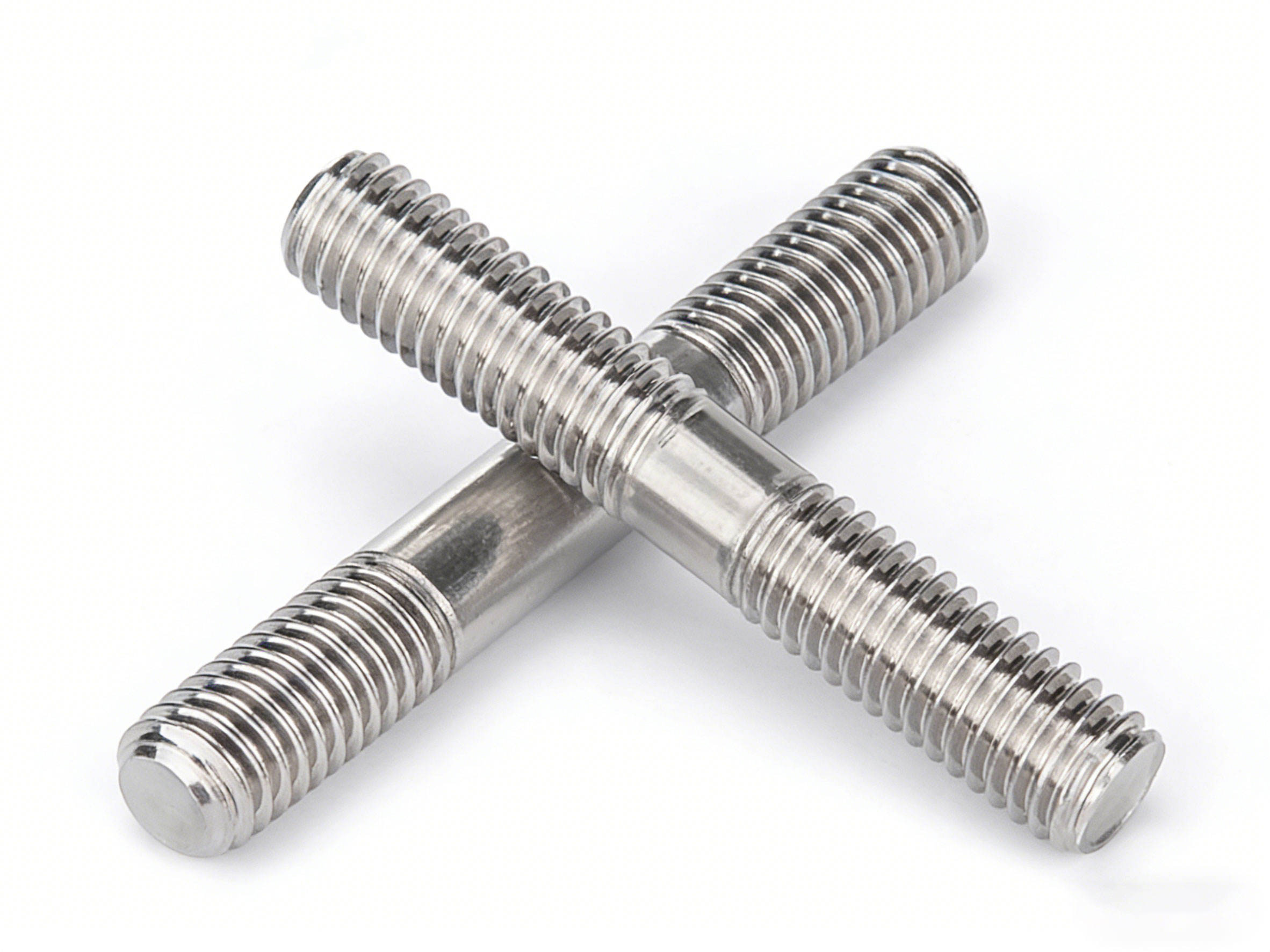
- Double-ended stud — a precision stud threaded at both ends, with a defined thread length at each end and a controlled plain shank or continuous thread in the middle. One end goes through the flange, the other takes a nut; both ends are threaded. Used on standard ASME B16.5 / B16.47 flange pairs.
- Tap-end stud — a stud with a short, controlled thread end into a tapped hole (equipment bonnet, valve body, heat-exchanger tube sheet) and a long thread end for the nut. The short-end engagement is calculated for the host material — typically one diameter in steel, more in cast iron or aluminium.
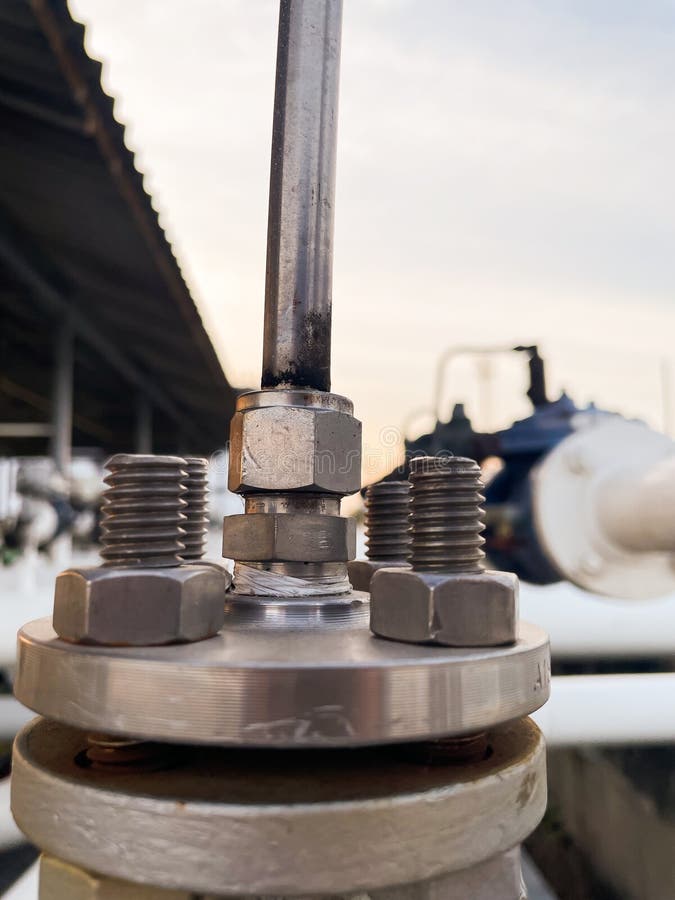
For refinery flange bolting on ASME B16.5 piping, the double-ended stud with two heavy hex nuts is the default. Tap-end studs appear on valve bonnets and pump casing covers where one side is inaccessible. Continuous-thread rod appears on pipe supports, spring hangers and baseplate anchoring.
When an RFQ says "B7 stud bolts, 2,000 pcs," we confirm which form the project actually needs, because the length tolerance, thread runout and end chamfer all change. A double-ended stud to a flange drawing is not the same product as a 3-metre all-thread bar cut on site.
4. Where All-Thread Bolting Goes in a Refinery
B7 and B7M stud and rod positions across a typical refinery or petrochemical unit:
| Position | Product form | Typical grade | Notes |
|---|---|---|---|
| Process piping flanges, B16.5 | Double-ended stud + 2 nuts | B7 / B7M | M16–M48 by flange class |
| Large B16.47 flanges, compressor nozzles | Double-ended stud | B7 / B16 | M48–M64, often tensioned |
| Heat-exchanger channel covers (API 660) | Double-ended stud | B7 / B16, sour per duty | 1-1/8"–2", tensioner protrusion required |
| Valve bonnets and pump casing covers | Tap-end stud | B7 / B7M | Short-end engagement calculated |
| Pipe supports and spring hangers | Continuous-thread rod | B7, often zinc-flake | Hanger adjustment length |
| Equipment baseplate anchoring | Continuous-thread rod / anchor | B7 or 8.8, HDG | Embedded or epoxy-grouted |
| Flange extension via long coupling nuts | Continuous-thread rod + coupling nut | B7 | Thread engagement controlled |
The two positions that drive the most custom orders: long studs for heat-exchanger channel covers where the tensioner bridge needs a specific protrusion above the nut, and extension rods joined by long coupling nuts where a spade or spacer is installed between flange faces. Both are cut and rolled to drawing length rather than adapted from stock bar on site.
5. Thread Rolling, Length and Runout
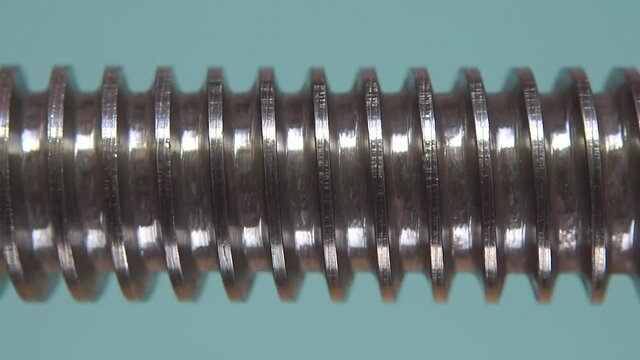
On a preloaded flange stud, the thread root is where fatigue cracks start. We roll threads after quenching and tempering on precision B7 and B7M studs, which produces a continuous grain flow around the thread form and work-hardens the surface at the root. The fatigue benefit of post-heat-treatment rolled threads over cut threads is directionally significant on cyclically loaded and vibration-prone joints; the actual magnitude depends on thread geometry, preload and surface condition, and should be confirmed against the joint analysis rather than treated as a fixed multiplier. Cut threads are acceptable on static hanger rods but are not the default for flange studs.
Length and end condition are where rod orders fail in the field:
- Overall length is cut and faced to a tolerance per drawing, commonly ±1 mm on precision studs, not the ±5 mm of stock bar.
- End chamfer — a 45-degree lead-in on both ends lets the nut start square and prevents cross-threading.
- Thread runout is controlled at the stud end so the nut can seat fully. A long runout leaves the nut standing on the tapered thread rather than the full thread.
- Protrusion above the nut — where hydraulic tensioning is used, the stud must protrude far enough for the tensioner bridge, and not so far that the nut bottoms out. This dimension is agreed on the drawing before production.
Site-cutting of all-thread bar to improvise a longer stud is a recurring turnaround problem: the cut end has an uncontrolled runout, no chamfer and a cold-worked shear surface that is not the equivalent of a rolled precision stud. Ordering the exact length is the cheaper option.
6. Coatings and Lubrication for a Stable K-Factor
The torque-to-preload conversion depends on the nut factor K, which is set by the thread lubrication and the bearing-surface condition. On a refinery flange bolt-up, the coating is part of the bolting specification, not an option:
| Finish | Typical use | Friction behaviour | Thread consequence |
|---|---|---|---|
| Plain / phosphate oil | Indoor, unit piping where re-lubricated at assembly | High, variable | Standard 6g / 2A fit |
| PTFE / Xylan dry film | Preferred for controlled torque tables; offshore-adjacent units | Low, stable, documented K | Thin film; standard thread fit retained |
| Zinc flake | External pipe racks, coastal refineries | Low, controlled | Thin film; low hydrogen risk on B7 |
| Hot-dip galvanized | Structural external bracing | Higher, scatter | Threads over-tapped (+0.4 mm typical) to fit |
| Black oxide / oil | Machined equipment bolting | Variable | Standard fit |
We supply PTFE dry-film coated B7 studs and nuts where the project wants a stable, documented friction condition so the PCC-1 torque table matches the delivered hardware. Where the crew applies anti-seize on site, the procedure records the product and batch, and the torque table is built for that condition. Changing the coating on a mid-project reorder without updating the friction data is a quiet way to lose preload on a hydrotest.
7. The Nuts: Half the Bolting Package
A flange stud is specified with its nuts, and the nut grade and proof load are not optional. We cover the full nut selection in our heavy hex nuts and coupling nuts guide; the points that matter for a B7 rod order:
- Use heavy hex nuts (ASME B18.2.2) on B7 flange studs, not standard hex nuts — the larger across-flats gives a lower bearing stress under the nut.
- Grade-match: 2H with B7, 2HM with B7M. A 2H nut on a B7M sour circle fails the hardness limit.
- Proof load on the nut is on the certificate; a nut that yields before the stud does unloads the joint.
- Hardened flat washers under the rotating nut spread the bearing load and prevent embedment into a soft flange face; washer hardness is matched to the stud.
- Long coupling nuts for stud extensions are supplied to the drawing length with controlled thread engagement at both ends.
Ordering "studs, 5,000 pcs" without the nuts, washers and coating condition is the most common RFQ shortcoming. The turnaround crew cannot build a torque table from a bag of loose studs.
8. Documentation MENA Inspectors Expect
On MENA refinery and petrochemical projects — Aramco, ADNOC, SABIC-type operator specifications and EPC QA/QC regimes — the bolting pack has to be traceable before the studs go into the flanges:
- EN 10204 3.1 material certificate, per heat, with chemistry and mechanical properties (tensile, yield, hardness)
- Hardness report per lot; 100% hardness on B7M / 2HM sour lots where the purchaser or project requires
- Proof-load and tensile report for the stud / nut combination
- Dimensional report: thread gauge fit (GO / NO-GO), overall length, protrusion above nut, end chamfer
- Coating report where coated (thickness, adhesion, salt-spray hours)
- PTFE / anti-seize batch reference where dry-film is applied at our end
- Heat-number traceability from bar mill certificate through to the bag label
For operator-witnessed lots — SGS, BV, TÜV, or the owner's turnaround QA — we hold the lot for witness testing before shipment rather than shipping first and certifying later. The heat number on the bag label is what lets the inspector tie the hardware in a specific flange back to the certificate during the turnaround audit.
9. How This Fits the PCC-1 Bolt-Up
This guide is about the hardware. The procedure that tells the crew how to install it is ASME PCC-1, and we cover the full bolt-up sequence — flange inspection, gasket seating, star-pattern staged passes, hydraulic tensioning and hot torquing — in our ASME PCC-1 refinery turnaround bolt-up guide.
The connection between the two: PCC-1 assumes the delivered stud, nut and washer are a qualified set with a known friction condition. A PCC-1 procedure built around PTFE-coated B7 sets does not work if the next shipment arrives plain-phosphate. When you order B7 studs from us, the friction condition and coating are stated on the quotation and the certificate, so the site procedure uses the torque table that matches the hardware on the flange.
10. Supplier Evaluation Card
Use this card when comparing B7 / B7M stud and rod suppliers for MENA refinery work. The points below are what operator QA/QC and EPC procurement teams typically ask us to demonstrate on a pre-project qualification.
| Evaluation point | What to ask the supplier | Why it matters |
|---|---|---|
| Finished-product certification | Do they test and certificate the finished stud to full ASTM A193, not just "B7 bar"? | Bar-stock B7 threaded on site is not an A193 product |
| Sour hardness control | Is B7M / 2HM held at ≤ 22 HRC with lot-by-lot readings? | Sour flanges fail inspection on hardness, not chemistry |
| Thread process | Are precision studs rolled after heat treatment? | Cut threads reduce fatigue margin on preloaded joints |
| Matched-set supply | Can they ship stud + heavy hex nut + hardened washer as one grade-matched set? | PCC-1 bolt-up assumes a qualified friction condition |
| Length / protrusion capability | Can they cut and roll studs to exact tensioner length? | Tensioner bridge needs controlled protrusion; site-cut studs are uncontrolled |
| Coating and friction | Is PTFE / zinc flake applied in-house with recorded friction? | The torque table depends on the measured nut factor |
| Certificate discipline | Are 3.1 certs in English, per heat, matching PO line items? | Inspectors stop the flange-up if the pack does not match labels |
| Heat traceability | Does the heat number flow from mill cert to bag label? | A flange closed up with untraceable studs cannot be signed off |
| Witness testing | Can they hold a lot for SGS / TÜV / owner witness before shipment? | Critical heat-exchanger covers are commonly witnessed |
| Repeat lead time | What is the repeat lead time for a mid-turnaround call-off? | Turnarounds do not wait for production schedules |
11. RFQ Dimensions: What to Send for a Complete Quotation
B7 stud and rod RFQs come back with clarifying questions most often because the flange list is attached without the grade, nut or coating. Send the following on the first request:
| RFQ field | Example | Notes |
|---|---|---|
| Source drawing | P&ID flange list, or flange drawing | Drives size, rating and service |
| Product form | Double-ended stud, tap-end stud, or continuous-thread rod | Different production and inspection routes |
| Size and length | M30 x 2 x 240, or 1-1/8"-8 x 10" | State protrusion if tensioning |
| Grade | A193 B7; A193 B7M if sour | State sour / H2S explicitly |
| Nuts and washers | 2H heavy hex + hardened washer, or 2HM for sour | Supplied as matched sets |
| Flange / equipment standard | ASME B16.5 Class 300, or API 660 channel cover | Drives stud length and quantity |
| Quantity | e.g. 120 sets per heat-exchanger cover | Counts per flange circle |
| Coating / lubrication | Plain, PTFE dry film, zinc flake, HDG over-tapped | Matches the torque-table nut factor |
| Tightening method | Torque, torque-turn, or hydraulic tensioner | Drives protrusion and thread condition |
| Certification | EN 10204 3.1; 3.2 with witness if required | Agreed before production |
| Delivery timing | Required on site before unit shutdown | Turnaround date is the hard deadline |
Send these fields, attach the flange list, and we return matched stud-nut-washer set quotations per flange — with grade, coating, friction condition and documentation scope agreed before the first stud is packed.
12. Common Field Mistakes
- Cutting B7 stock bar and calling it A193 B7. Bar chemistry alone is not the finished-product certification. Order finished studs to the full standard.
- Mixing grades on a sour flange. One 2H nut on a B7M circle breaks NACE MR0175 compliance. The whole joint, washers included, stays on the sour heat treatment.
- Ordering "studs" without nuts and washers. Without the matched nut grade and the friction condition, the torque table cannot be built.
- Cut threads on flange studs. Cheaper to make, but the interrupted grain flow at the thread root cuts fatigue margin. Specify post-heat-treatment rolling on preloaded studs.
- No lubrication control. Torque on a dry, rusty stud delivers a fraction of the intended preload. Record the coating or anti-seize batch.
- Wrong stud length for tensioning. Too short and the tensioner cannot grip; too long and the nut protrudes past the stud end.
- Site-cutting all-thread bar on the day. Uncontrolled runout and chamfer. Order the exact length.
- Changing coating mid-project. A different coating changes K. Reissue the torque table or keep the friction condition constant.
FAQ
Q: What is the difference between A193 B7 and B7M? A: They are the same Cr-Mo alloy, but B7M is heat-treated to a hardness capped at HRC 22 maximum for wet H2S (sour) service under NACE MR0175 / ISO 15156. B7 is the general-service condition. The companion nuts follow the same split: 2H with B7, 2HM with B7M.
Q: Can I use continuous-thread rod instead of a double-ended stud on a flange? A: For general low-pressure piping it is common practice, but for pressure-boundary flanges on refinery service a precision double-ended stud with controlled runout, rolled threads and a certified set is the specified product. The inspection and traceability expectations are different.
Q: What size range do you supply in B7? A: M16 to M64 (5/8" to 2-1/2"), with imperial 3/4" to 2-1/2" covered on request. M16–M48 covers most ASME B16.5 piping classes; M48–M64 appears on large B16.47 flanges and heat-exchanger covers.
Q: Are your B7 threads rolled or cut? A: Precision flange studs are thread-rolled after quenching and tempering. Cut threads are used only where the drawing specifies a static hanger rod and the cost trade-off is accepted.
Q: Do you supply the matching nuts and washers? A: Yes. B7 studs are supplied as matched sets with A194 2H heavy hex nuts (2HM for sour) and hardened flat washers, with the grade match and friction condition documented on the pack.
Q: What certificates come with a B7 order? A: EN 10204 3.1 per heat, with chemistry, mechanicals, hardness, proof-load and thread-gauging records. 100% hardness on B7M sour lots where specified. 3.2 with SGS / TÜV witness is arranged where the operator requires it.
Request a Quotation
Send the flange list or the P&ID bolting schedule above, and we will return matched B7 / B7M stud-nut-washer set quotations per flange — grade, length, coating, friction condition and documentation scope — within one working day, timed to your turnaround or construction window.
Email: factory@glfastener.com | WhatsApp / WeChat: +86 166 6309 4647
We supply refinery and petrochemical bolting as complete, documented flange packages, with the certification and lubrication scope agreed at quotation so the delivered hardware supports the bolt-up procedure rather than working against it.
Related guides: Oil & Gas Fastener Manufacturer & Stud Bolt Center, Heavy Hex Nuts & Coupling Nuts, ASME PCC-1 Refinery Turnaround Bolt-Up