ASTM A194 2H / 2HM Heavy Hex Nuts & Coupling Nuts: A Buyer's Field Guide for Oil & Gas Flange Bolting
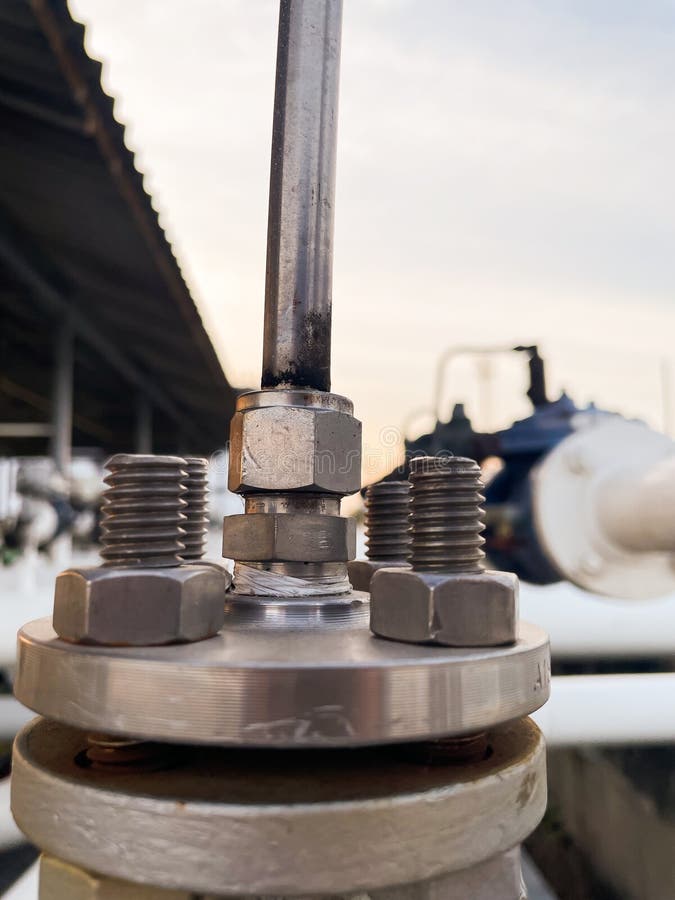
A flange joint on a refinery pipe rack does not leak because the nut was the wrong colour. It leaks because the nut grade was never matched to the stud, the proof load was not on the certificate, or a long coupling nut was substituted for a standard nut on an extension stud without anyone checking thread engagement. By the time the hydrotest crew finds it, the bolting has already been delivered, labelled and bagged.
Gangluo manufactures heavy hex nuts and long coupling nuts for oil & gas stud bolt and flange bolting assemblies in MENA and GCC service, to ASTM A194 2H and 2HM, with grade matching against the bolt, proof-load verification and a documentation package that project QA/QC inspectors accept on first review. This guide covers what a buyer should actually put on the order, what the inspection will check, and where the common substitutions go wrong.
Gangluo Heavy Hex Nuts — Quick Reference
- Grades: ASTM A194 2H, 2HM (sour-service hardness-controlled), 8 / 8M stainless
- Dimensions: ASME B18.2.2 heavy hex; ISO 4033 / ISO 4032 metric where specified
- Sizes: 1/2" to 2-1/2" (M12 to M64); M16–M36 covers most piping classes
- Coupling nuts: long hex for stud extension and rod coupling, custom length per drawing
- Hardness: 2H ~HRC 24–35; 2HM capped at ≤ 22 HRC / 237 HBW for sour service
- Certification: EN 10204 3.1 material cert, proof-load report, hardness report
- Finishes: plain, phosphate and oil, PTFE / Xylan dry film, zinc flake, HDG (over-tapped)
1. Why the Nut Is Not a Commodity
On a pressure-containing flange, the bolt is the component the designer expects to yield first in an overload event. The nut must not strip, crack or embed before that point. That single design rule drives everything about nut specification: the nut's proof load must meet or exceed the bolt's tensile requirement, its hardness must sit in a controlled band, and its bearing face must be large enough not to crush the flange under preload.
A standard hex nut has a smaller width across flats and a thinner body. On a 1-1/8" B7 stud torqued to its design preload, a standard nut can embed into a raised-face flange, reduce clamp load and start a slow leak path. The heavy hex nut exists because its larger bearing area spreads that load. It is the default nut for ASME B16.5, B16.47 and API flange bolting, and it is what the bolting schedule on most refinery and pipeline drawings calls for.
The coupling nut — a long hex nut used to join two threaded ends, typically on extension studs or threaded rod — is a separate geometry. It is not simply a longer heavy hex; the thread length and engagement depth are engineered so that the bolt rod yields before the internal thread strips. Getting the coupling length wrong is a common field failure on tie-rod and extension applications.
2. ASTM A194 Grades: 2H vs 2HM
ASTM A194 covers nuts for high-temperature and high-pressure service. The two grades a buyer will encounter on almost every MENA flange inquiry are:
| Grade | Material | Proof load (typical) | Hardness | Typical service |
|---|---|---|---|---|
| 2H | Carbon / alloy steel, hardened and tempered | ~175 ksi (~1200 MPa) | HRC 24–35 | General hydrocarbon service, paired with A193 B7 / B16 studs |
| 2HM | Carbon / alloy steel, controlled composition and heat treatment for sour service | ~150 ksi (~1030 MPa) | ≤ 22 HRC / 237 HBW | Sour service (H₂S), paired with B7M / L7M studs |
| 8 | Austenitic stainless (304) | ~80 ksi | Rockwell B / C per A194 | Corrosive service, paired with B8 studs |
| 8M | Austenitic stainless (316) | ~80 ksi | per A194 | Corrosive / chloride service, paired with B8M studs |
The mechanical point buyers often get backwards: the nut is not selected to be "stronger" than the bolt in a raw-stress comparison. A194 2H nuts carry proof-load requirements sized to pair with A193 B7 studs, so the assembly can be preloaded to design clamp load without stripping the internal thread or embedding the nut face. The joint is designed so the stud yields in overload before the nut strips. If you have ever received a quote that speculates on a "grade 5" nut for a B7 stud, that is a substitution that has not been thought through.
Sour service: the 2HM difference
In H₂S-containing production, gathering and wellhead service, sulfide stress cracking (SSC) is the controlling risk. Under NACE MR0175 / ISO 15156, carbon and low-alloy steel fasteners are capped at 22 HRC (237 HBW). A standard 2H nut, heat-treated to HRC 24–35, would exceed that limit. The 2HM grade is not simply a 2H nut run soft: it carries a controlled composition and a documented quench-and-temper heat treatment, with hardness capped at ≤ 22 HRC / 237 HBW per NACE / ISO 15156 and the hardness reading verified lot by lot.
The practical procurement consequence: when a project specifies sour service, the nut on the certificate must read 2HM, not 2H. A 2H nut produced "soft" by accident is not 2HM — 2HM is a grade with a documented heat treatment and a hardness band, and the certificate must say so. We hold 100% hardness testing on every 2HM lot, with individual readings printed on the 3.1 certificate, because that is what major MENA operators and EPC contractors typically expect to see on their sour-service inspection packs.
3. Heavy Hex Nut Dimensions and Thread Fit
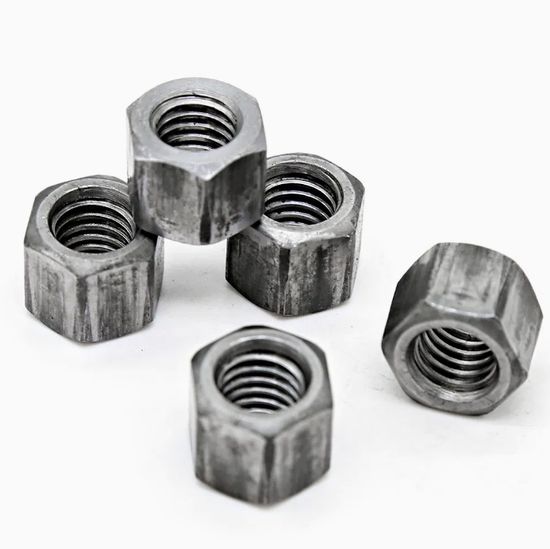
Heavy hex nuts are dimensioned to ASME B18.2.2 (imperial) or ISO 4033 (metric heavy hex) and are threaded to match the bolt — same nominal diameter, same pitch. The width across flats is larger than a standard hex nut so the bearing area grows.
| Thread size | Width across flats (approx.) | Nut thickness (approx.) | Typical proof load |
|---|---|---|---|
| 1/2" (M12) | 3/4" (19 mm) | 7/16" (11 mm) | ~85 kN |
| 5/8" (M16) | 1-1/16" (27 mm) | 35/64" (14 mm) | ~120 kN |
| 3/4" (M20) | 1-1/4" (32 mm) | 41/64" (16 mm) | ~190 kN |
| 7/8" (M24) | 1-7/16" (36 mm) | 29/32" (19 mm) | ~270 kN |
| 1-1/8" (M30) | 1-13/16" (46 mm) | 1-15/32" (29 mm) | ~420 kN |
| 1-3/8" (M36) | 2-3/16" (55 mm) | 1-3/4" (44 mm) | ~610 kN |
Thread fit matters more than buyers sometimes assume. On plain (uncoated) nuts, the internal thread is manufactured to the standard thread gauge and assembles freely on a standard bolt thread. On hot-dip galvanized nuts, the zinc layer builds up on the internal thread, so the nut is over-tapped — typically about +0.4 mm over standard — to assemble over the coated bolt. If the HDG nut is not over-tapped, the fitter either cannot run it on or damages the coating on the bolt thread during assembly, and the friction coefficient the torque table assumed is gone.
For PTFE / Xylan dry-film coated nuts, the coating is thin enough that thread gauging remains close to standard, but the friction coefficient drops and stabilises, which is exactly why coated nuts produce a more repeatable preload. The coating type belongs on the order and on the certificate so the installation team uses the right torque table.
A note on standards scope: ASTM A194 governs nuts for high-temperature and high-pressure service — i.e. pressure flanges, valve bonnets and pressure-containing equipment bolted to ASME B16.5 / B16.47 / API flanges. ASTM A563 covers carbon and alloy steel nuts for general structural and mechanical use, and ASME B18.2.2 is the dimensional standard for the hex nut itself. The three are not interchangeable: a structural A563 DH nut is not automatically acceptable on an A193 B7 pressure flange, and a B18.2.2 dimension alone does not confer the proof-load or heat-treatment requirements of A194. When the drawing calls up a pressure-service flange, specify A194; when it is a structural connection, A563 is the usual reference.
4. Coupling Nuts: When a Long Hex Is Not Just a Long Nut
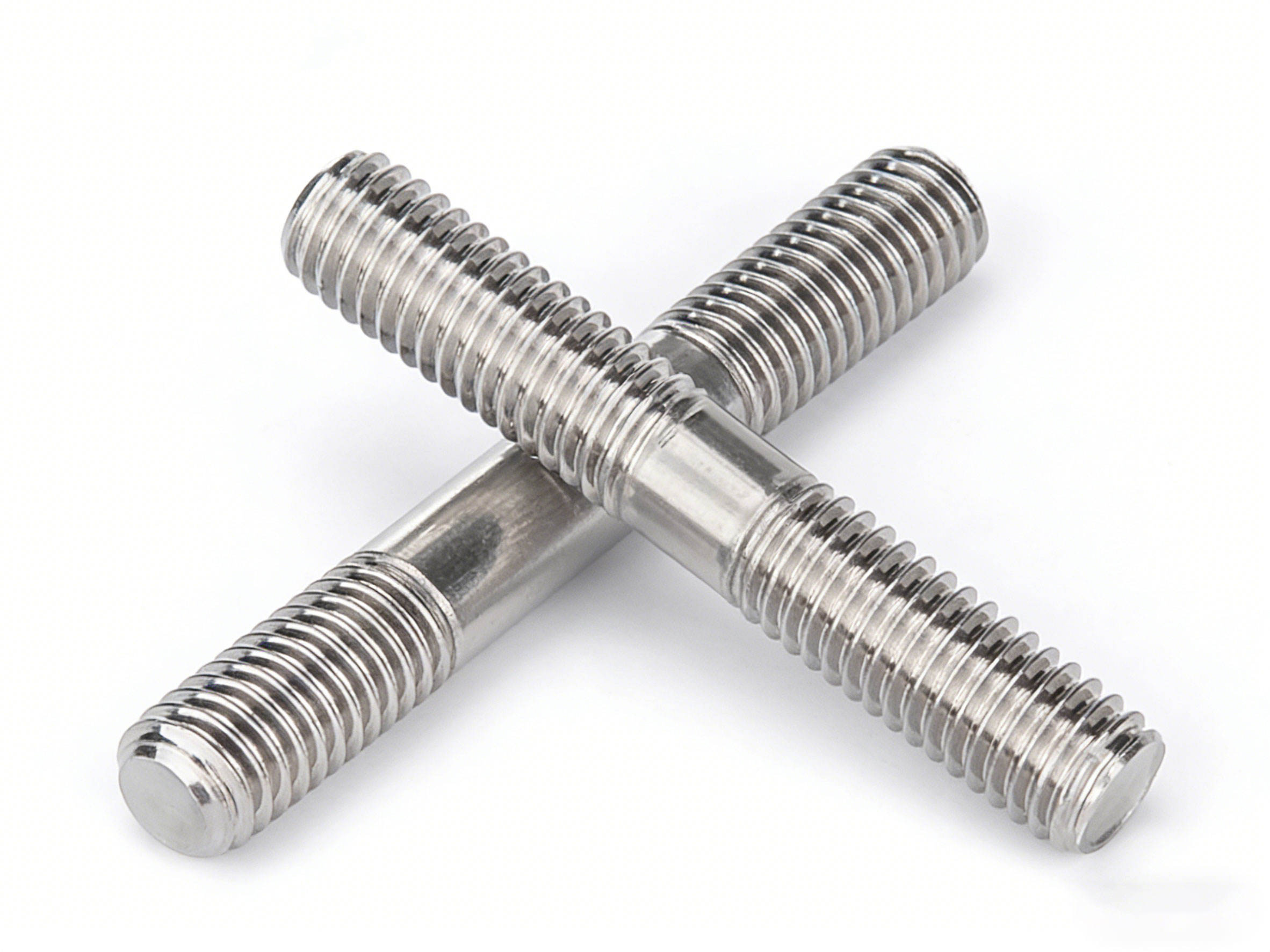
A coupling nut (also called a long nut, extension nut or rod coupling) is an internally threaded hex body used to join two externally threaded components end to end. Typical oil & gas uses include extending a stud between flanges where the standard stud length is too short, joining lengths of threaded rod for hangers and bracing, and assembling anchor or tie-rod assemblies in structural and foundation applications.
The design rule for a coupling nut is thread engagement. The internal thread must be long enough that the rod yields before the internal thread strips — which, for a steel rod in a steel nut, is commonly used as a starting point of roughly one rod diameter of engagement per side, and often 1.5 diameters per side on safety-critical joints. These are rules of thumb: the actual required engagement should be verified against the host material thread standard and the project's joint calculation, because engagement depends on the relative strengths of rod and nut materials, thread class, and the load case. A coupling nut that is too short looks the part on the bench but strips at first overload.
Coupling nuts on oil & gas projects are frequently drawn to custom length, not to a catalogue dimension. The buyer's drawing should state:
- Thread size and pitch on each end (they may differ on stepped coupling nuts)
- Overall length of the coupling nut
- Width across flats (heavy hex series, or a specified across-flats dimension)
- Grade (2H / 2HM / stainless)
- Whether both ends are threaded through, or one end is a blind hole
We produce coupling nuts to customer drawings in grades up to 2HM, with the same proof-load and hardness documentation as standard heavy hex nuts. On extension-stud jobs, it is worth asking the workshop whether the coupling nut will be visible after assembly — if it will be buried or inaccessible, the traceability marking and hardness report become more important, not less.
5. Grade Matching: The Combinations Buyers Actually Specify
A nut is never ordered on its own. It is half of an assembly, and the grade match is checked at inspection. The standard combinations in MENA oil & gas bolting are:
| Stud bolt | Matching nut | Application |
|---|---|---|
| ASTM A193 B7 | ASTM A194 2H | General refinery / pipeline flange bolting |
| ASTM A193 B7M | ASTM A194 2HM | Sour service, H₂S production |
| ASTM A193 B16 | ASTM A194 2H | High-temperature service (up to ~595 °C) |
| ASTM A320 L7 / L7M | ASTM A194 7 / 7M | Low-temperature service, impact-tested |
| ASTM A193 B8M (Class 1/2) | ASTM A194 8M | 316 stainless corrosive service |
| ASTM A320 L7 | ASTM A194 4 | Low-temperature carbon steel |
The mistake we see most in incoming RFQs is a stud bolt grade with no nut grade at all — for example, "B7 studs, 2,000 pcs" and nothing else. Without the nut grade there is no proof load target, no hardness band and no way to confirm sour-service compliance. The second most common mistake is pairing a B7M sour stud with a plain 2H nut, which fails NACE compliance because the nut hardness is too high. State the nut grade on the PO, and the certificate scope is agreed before production starts.
Where the joint moves into corrosive or sour-seawater territory — for example on offshore pump flanges, splash-zone hardware or desalination piping — the bolting material itself changes. Our Inconel 625 fasteners for sour and seawater service guide covers the nickel-alloy route; the same grade-matching logic applies, with 625 nuts paired to 625 studs to avoid galvanic mismatch.
6. Hardened Washers and the Bearing Face
The nut does not bear directly on the flange on high-preload joints. A hardened washer sits under the rotating nut (and under the bolt head at the other side) to spread the load and prevent the nut from embedding into the flange face. We cover the washer selection in detail in our hardened washers for oil & gas flanges guide, but the nut-side consequence is worth stating here:
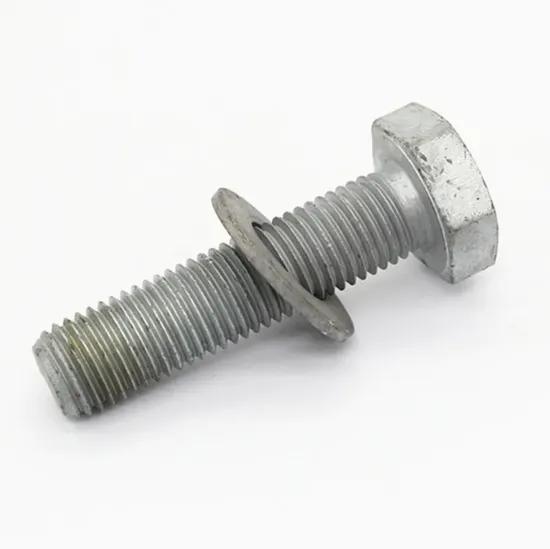
- The washer hardness must be matched to the nut and bolt — a soft commercial washer under a 2H nut on a B7 stud will embed, lose preload and show up as flange leakage.
- For EN 14399-style preloaded assemblies, the washer is part of the qualified set; substituting a visually similar washer invalidates the friction and preload calibration.
- On sour-service joints, the washer hardness limit follows the same NACE MR0175 ceiling as the nut.
When you ask us for a nut quotation, we will usually confirm whether the washer is included in the set or supplied separately — because the certificate package and the friction coefficient depend on it.
7. Documentation Package for Project Inspection
Every Gangluo nut order ships with a documentation pack that is agreed at quotation, not improvised at delivery. The pack a MENA project QA/QC team expects:
- EN 10204 3.1 material certificate, with chemical composition and mechanical properties, per heat
- Proof-load test report, per the applicable ASTM A194 / ASME B18.2.2 requirement
- Hardness report — lot-by-lot, with individual readings; 100% coverage on 2HM sour lots
- Dimensional inspection report: thread gauging, width across flats, thickness
- Coating report where coated nuts are supplied (thickness, adhesion, salt-spray hours per spec)
- Marking record: grade mark and manufacturer's mark stamped on the nut face
For projects requiring third-party witness (SGS, BV, TÜV, or the owner's inspector), we arrange 3.2 certification and hold the lot for witness testing rather than shipping first and certifying later. The heat number runs from the incoming bar mill cert through to the box label, so an inspector can trace any bag of nuts back to the heat.
8. Supplier Evaluation Card
Use this card when comparing nut suppliers on a sour-service or pressure-flange inquiry. The points below are what we build into our own supply, and what buyers on MENA projects typically ask us to demonstrate.
| Evaluation point | What to ask the supplier | Why it matters |
|---|---|---|
| Grade control | Can they show 2HM with ≤ 22 HRC readings on every lot, not just a material cert? | Sour-service compliance fails on hardness, not chemistry |
| Proof-load capability | Is proof load tested in-house or outsourced? Is the report per lot? | No proof-load report = no pressure-service acceptance |
| Heat traceability | Does the heat number flow from mill cert to box label? | Inspectors trace every bag; breaks in traceability stop delivery |
| Coating process | Is PTFE / zinc flake / HDG in-house or subcontracted? Who controls thread over-tap? | Coating changes friction; subcontracted coating often loses thread control |
| Coupling nut capability | Can they produce custom-length coupling nuts to drawing, with engagement calculations? | Catalogue long nuts are often under-engaged |
| Certificate language | Are 3.1 certificates issued in English with the project PO line item? | Owner inspectors reject handwritten or non-conforming certs |
| Sour-service experience | Can they reference completed NACE / ISO 15156-compliant deliveries on MENA projects? | Sour-service QA discipline is learned, not assumed |
| Lead time on repeats | What is the repeat-order lead time for a previously qualified lot? | Reorder speed on flange shutdowns is a project-critical number |
9. RFQ Dimensions: What to Send to Get a Quote Back in One Cycle
The reason most nut RFQs come back with clarifying questions is that the order is missing two or three dimensions. Send the following on the first request and the quotation comes back complete:
| RFQ field | Example | Notes |
|---|---|---|
| Product type | Heavy hex nut / long coupling nut | Coupling nuts need length and thread-engagement detail |
| Thread size and pitch | 1-1/8"-8 UNC, or M24 x 3 | State imperial or metric explicitly |
| Grade | A194 2H, or 2HM for sour | Do not leave grade blank |
| Standard | ASME B18.2.2 heavy hex, or ISO 4033 | Dimension series follows this |
| Quantity | e.g. 10,000 pcs, or 5,000 sets with studs | Sets vs loose nuts changes packing |
| Coating | Plain / PTFE / zinc flake / HDG | HDG nuts require over-tap |
| Hardness requirement | ≤ 22 HRC if sour; otherwise per A194 | State the limit, do not assume |
| Certificate scope | EN 10204 3.1; 3.2 with SGS witness if required | Agreed at quotation, not at delivery |
| Marking | Grade + manufacturer mark stamped | Required for field traceability |
| Packaging | VCI bags, count per box, pallet labels | Needed for site inventory control |
Reply with these fields and we return a quotation with the grade, proof-load scope and certification matched to the offer — no follow-up round trip.
10. Common Field Mistakes
- Mixing 2H and 2HM on the same sour flange. A single 2H nut in a sour-service joint exceeds the hardness limit. The whole lot must be 2HM.
- Using a standard hex nut on a heavy-hex stud. The across-flats dimension is smaller, the bearing area is smaller, and the torque table in the project procedure assumes a heavy hex.
- HDG nuts not over-tapped. The nut will not run onto the coated bolt, or will gall during assembly.
- Coupling nuts too short. On extension studs, a coupling nut shorter than the rod diameter on each side strips before the rod yields.
- Reusing nuts. Nuts are stretched and work-hardened on first installation; re-torquing a previously used nut gives an unpredictable preload. Project bolting procedures almost always specify new nuts on reassembly.
FAQ
Q: What is the difference between a heavy hex nut and a standard hex nut?
A: A heavy hex nut has a larger width across flats and a thicker body, giving greater bearing area and higher proof load. It is the specified nut for stud bolt and flange bolting under ASME B18.2.2 / ISO 4033; a standard hex nut does not have the bearing area for pressure-service preload.
Q: Is 2H the same as a high-strength nut?
A: 2H is a hardened and tempered carbon / alloy steel nut grade in ASTM A194, paired with high-strength studs like A193 B7. Its proof load sits above the stud's tensile requirement so the stud yields in overload before the nut strips.
Q: When do I need 2HM instead of 2H?
A: Whenever the service contains H₂S (sour service) and the project references NACE MR0175 / ISO 15156. 2HM caps hardness at 22 HRC / 237 HBW; standard 2H runs harder and would not be compliant.
Q: Can coupling nuts be supplied in 2HM?
A: Yes. We produce long coupling nuts to drawing in 2H, 2HM and stainless grades, with the same proof-load and hardness documentation as standard heavy hex nuts. The thread engagement length should be confirmed against the stud diameter.
Q: Do you supply the matching studs and washers?
A: Yes. Heavy hex nuts, coupling nuts, studs and hardened washers are supplied as matched bolting sets, with the grade match and friction / coating condition documented on the certificate. See our oil & gas stud bolt center for the full range.
Q: What certificates are included?
A: EN 10204 3.1 material certificates with chemistry, mechanical properties, hardness and proof-load results. 3.2 certificates with third-party witness (SGS / BV / TÜV) are arranged where the project requires.
Request a Quotation
Send the RFQ dimensions above to our engineering team and we will confirm grade, proof-load scope, coating and documentation within one working day. For sour-service and pressure-flange packages, attach the bolting schedule or flange drawing and we will return a matched nut-and-stud set quotation.
Email: engineering@glfastener.com
We supply heavy hex nuts and coupling nuts as part of complete flange bolting packages, with the documentation pack agreed at quotation so the delivered certificates match the commercial order.
Related guides: Oil & Gas Fastener Manufacturer & Stud Bolt Center, Hardened Washers for Oil & Gas Flanges, Inconel 625 Fasteners for Sour & Seawater Service